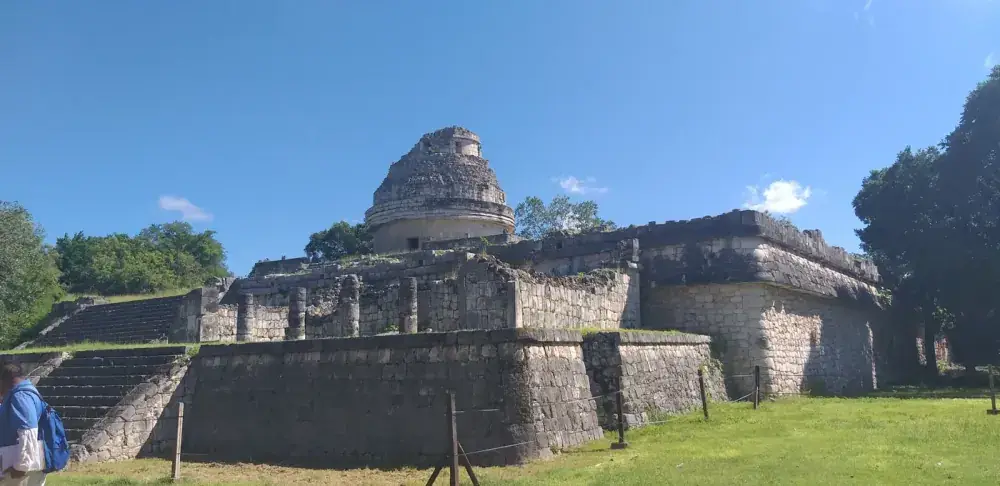
El Caracol: The Maya Observatory at Chichen Itza
El Caracol is the round observatory at Chichen Itza, named the snail in Spanish for the spiral staircase that winds up inside its tower. Maya astronomers used its carefully placed windows to track the sun and, above all, the planet Venus. Built around the 9th to 10th century, it is one of the few circular buildings the Maya ever raised.
What is El Caracol, and what does the name mean?
El Caracol is the observatory at Chichen Itza, a round stone tower that ancient Maya astronomers used to watch the sky. The name is Spanish for the snail, given by later explorers because of the spiral staircase coiling up inside the tower. To the Maya, this was a place to read the movements of the sun, the stars, and the planet Venus, which guided their calendar and their rituals.
Where is El Caracol at Chichen Itza?
El Caracol stands in the southern part of the Chichen Itza site, near the group of buildings known as the Nunnery, a short walk from the main plaza. Its rounded tower is easy to pick out among the site's square and stepped buildings. The tower rises about 23 meters (75 feet) on two broad rectangular platforms, with a staircase on the west side flanked by balustrades carved with intertwined serpent heads.
What was El Caracol used for?
El Caracol was an astronomical observatory. Maya astronomers watched the sky through narrow windows set into the top of the tower, and the openings line up with key points in the movement of the sun and the planet Venus. The flat Yucatan landscape has no hills or natural markers to fix these positions, so the Maya built their own marker in stone. Tracking Venus mattered because its cycle was tied to the Maya calendar, to warfare, and to the timing of planting and harvest.
The design of the observatory
El Caracol is built as three stacked structures: a round tower set on a rectangular platform, which sits on a second, larger platform. Inside, two concentric walls enclose circular chambers, and the spiral staircase climbs to the observation level. A frieze above the doorways carries a mask of Chaac, the rain god, framed by feathers and serpents. The circular form is rare in Maya architecture, which favored straight lines and square bases, and it is part of what makes the building stand out.
Maya astronomy at Chichen Itza
The Maya were among the finest astronomers of the ancient world. From places like El Caracol they tracked the sun, the moon, and the planets, predicted eclipses, and measured the length of the solar year with striking accuracy. These observations were not idle science: they fed directly into the Maya calendar and shaped when ceremonies, wars, and harvests took place. The same astronomy is built into El Castillo, whose steps and shadow mark the solar year.
Can you go inside El Caracol?
No. Like the other major structures at Chichen Itza, El Caracol is roped off and cannot be entered or climbed. Visitors view the observatory from the surrounding path, where the round tower and its platforms are easy to see and photograph from several angles.
Seeing El Caracol today
El Caracol sits along the walking route through the southern end of the Chichen Itza archaeological zone and is one of the most distinctive of the Yucatan's Mayan ruins. Seeing it with its astronomical purpose in mind turns a round tower into a working instrument. Plan the site hours, tickets, and route on the Chichen Itza destination guide.