
Izamal: The Yellow City of Yucatan
Izamal is one of the few places in Mexico where two civilizations are simultaneously visible in a single view. Large Maya pyramids rise directly from the colonial urban fabric — 16th-century Spanish buildings constructed immediately adjacent to or on top of ancient Maya structures, the whole city painted the same bright ochre-yellow in every direction. There is no equivalent in Mexico.
The yellow tradition began in 1993 when the city was repainted for Pope John Paul II's visit — the ochre chosen to represent the sun, significant in both Maya cosmology and Catholic symbolism. It has been maintained ever since, giving Izamal one of the most visually distinctive historic centers in the country. The city holds Pueblo Mágico designation from the Mexican federal government, recognizing towns of exceptional cultural significance.
Izamal is 72 km east of Merida — one hour by car. For visitor hours, Kinich Kakmó climbing rules, and half-day pacing, use the Izamal visitor guide. It pairs naturally with a multi-day private Yucatan tour that combines it with Merida, Valladolid, and Chichen Itza. Compare other archaeology sites in the Mayan ruins hub. The city is compact enough to explore properly in 2–3 hours, making it an ideal half-day stop rather than a full-day destination.
Quick Facts: Izamal
| Nickname | La Ciudad Amarilla — The Yellow City |
| Designation | Pueblo Mágico — federal recognition for exceptional cultural heritage |
| Location | Central Yucatan, 72 km east of Merida |
| Distance from Merida | ~72 km east — approximately 1 hour by car |
| Distance from Cancun | ~180 km west — approximately 2 hours by car |
| Distance from Valladolid | ~85 km west — approximately 1 hour by car |
| Kinich Kakmó Pyramid | Third largest in Mexico by base area (168 x 173 m) — free entry |
| Franciscan Convent | Built 1561 — one of the largest convent atriums in the Americas |
| Yellow Tradition | Established 1993 for Pope John Paul II's visit — maintained ever since |
| Best Time to Visit | Morning (before 11 AM) for cooler temperatures and better photography light |
Kinich Kakmó — The Pyramid Inside the City
Kinich Kakmó is the third largest pyramid in Mexico by base area — 168 by 173 meters at its base — and it sits in the middle of Izamal's colonial urban grid. This is not an archaeological zone separated from the town by a fence and a ticket booth. The pyramid rises directly from the city streets, with houses and businesses built up against its lower terraces on three sides.
The pyramid was dedicated to Kinich Ahau, the Maya sun deity. Entry is free and the structure is open daily from 8 AM to 5 PM. Climbing to the summit provides panoramic views over the yellow colonial city, the convent facade, and the flat Yucatan landscape extending to the horizon. It is an active INAH archaeological site — excavation and restoration work continues.
Izamal had at least 12 large ceremonial pyramids at its peak during the Classic period (250–900 CE). Most were partially demolished by Spanish colonizers, their stone reused for churches and civic buildings. Kinich Kakmó survived because its scale made demolition impractical. The result is a Maya pyramid embedded in a functioning colonial city — an arrangement found nowhere else in Mexico at this scale.
The Franciscan Convent of San Antonio de Padua
The Franciscan Convent, completed in 1561, was built directly on top of a Maya ceremonial platform — the foundation stones of the ancient structure visible in several places. The convent's atrium covers approximately 8,000 m² and is one of the largest open-air atriums in the Americas. It was designed to accommodate the indigenous population during outdoor mass — the building inside was too small for the numbers involved.
The image of Our Lady of Izamal (Nuestra Señora de Izamal), housed in the sanctuary, has been venerated since the 16th century and remains one of the most important pilgrimage sites in the Yucatan Peninsula. Religious processions and pilgrimages occur throughout the year. The convent is free to enter — religious services occur continuously through the day, so quiet and respectful behaviour is required inside the sanctuary.
The yellow-painted facade of the convent is the most photographed view in Izamal. Early morning before 9 AM and late afternoon after 4 PM offer the best light — the east-facing facade is front-lit in the morning, the plaza in shade and cooler to walk.
The Yellow City: Streets, Calesas & Artisan Workshops
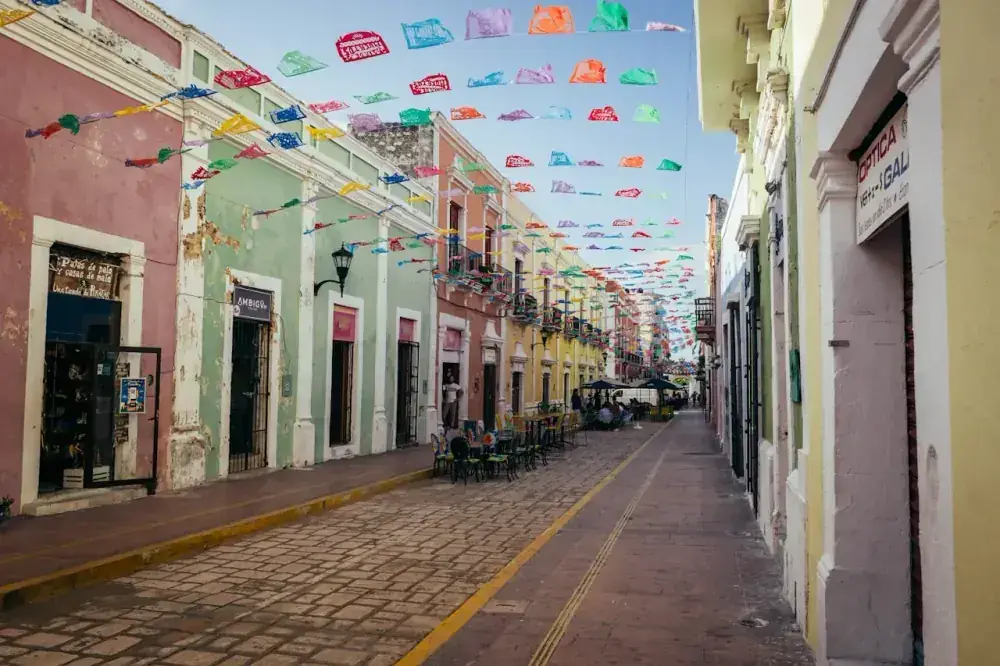
Beyond the pyramid and convent, Izamal's historic center rewards slow walking. The visual coherence of the yellow — applied to every building regardless of function, from the municipal palace to private homes — creates an atmosphere that is distinctly different from any other colonial Mexican town. The light in the streets changes the color temperature of the yellow throughout the day; morning ochre, midday gold, late afternoon amber.
Horse-drawn calesas (carriages) wait in the main plaza and offer 45–60 minute tours of the city's highlights with local driver commentary on the pyramids, convent history, and yellow city tradition. They are a practical and traditional way to cover ground in the heat — particularly useful from May to October when midday temperatures exceed 35°C.
Izamal is known for traditional Yucatecan crafts — embroidered huipil textiles, hammock weaving, and painted alebrijes. Several family workshops in the historic center are open to visitors. A local guide navigates to workshops that are typically off the main tourist route and allows direct purchase from artisans rather than from market stalls.
How to Visit Izamal from Merida, Cancun, or Valladolid
From Merida, Izamal is 72 km east on Highway 180 — approximately 1 hour by car. Merida is the most natural base for an Izamal visit. Tours from Merida can combine Izamal with Chichen Itza or Valladolid on a single day — Izamal is best visited in the morning before the heat, then onward to Chichen Itza for the late morning and early afternoon.
From Cancun, Izamal is 180 km west — approximately 2 hours by car. It is most practical as part of a multi-stop itinerary rather than a standalone day trip from Cancun. Private tours from Cancun that include Izamal typically combine it with Chichen Itza and Valladolid on a multi-day Yucatan itinerary.
From Valladolid, Izamal is 85 km west — approximately 1 hour. The two colonial cities pair naturally on a Yucatan interior day: Izamal's yellow buildings and Maya pyramid in the morning, Valladolid's cenotes and market in the afternoon. A multi-day private Yucatan tour is the most complete format for covering both cities alongside Chichen Itza and the archaeological sites.
Practical Tips for Visiting Izamal
- Visit in the morning — Izamal is small and best explored before 11 AM. The city heats up significantly by midday, particularly from May to October when temperatures reach 35°C+. Morning light on the yellow buildings is the best for photography.
- Kinich Kakmó pyramid is free — open 8 AM–5 PM daily. No guide required, though a certified INAH guide adds significant historical context to the iconography and construction history.
- The convent is free to enter — religious services occur throughout the day. Quiet behaviour is required inside the sanctuary; the atrium and exterior are open for general visiting.
- Take a calesa for efficiency — horse-drawn carriages in the plaza cover the main highlights in 45–60 minutes with commentary. Useful when time is limited or heat is a factor.
- Try Yucatecan food in the plaza — the main plaza restaurants serve regional specialties: papadzules (tortillas in pumpkin seed sauce), sopa de lima, and poc chuc. Better quality and lower prices than Cancun or Merida tourist areas.
- Izamal is a half-day stop — 2–3 hours covers the pyramid, convent, and a walk through the historic center comfortably. Plan it as a stop on a multi-destination Yucatan day rather than as a standalone full-day destination.
Key Takeaways
- Izamal is the only place in Mexico where large Maya pyramids and colonial Spanish architecture exist side-by-side at this scale — both visible from the same point in the street.
- Kinich Kakmó is the third largest pyramid in Mexico by base area — free entry, open 8 AM–5 PM, panoramic views from the summit.
- The Franciscan Convent (1561) has one of the largest open-air atriums in the Americas — built on a Maya platform, free entry.
- The yellow color tradition was established in 1993 for Pope John Paul II's visit and has been maintained ever since — every building in the historic center is the same ochre-yellow.
- Best visited in the morning before 11 AM — 2–3 hours is enough for a complete visit.
- From Merida: 72 km east, 1 hour. From Cancun: 180 km west, 2 hours. From Valladolid: 85 km west, 1 hour.
- See the Multi-Day Yucatan Private Tour to combine Izamal with Merida, Valladolid, and Chichen Itza.
- Browse tours from Merida or tours from Cancun for departure options.
Recommended Tours for Izamal Visitors
Helpful Next Steps for Izamal
Choose the next step that matches how you want to experience Izamal, from a private guided tour to nearby stops or the wider area.
Multi-Day Yucatan Private Tour
The most natural way to include Izamal — combined with Merida, Valladolid, and Chichen Itza in a single private itinerary.
View detailsMerida — 72 km West
The cultural capital of Yucatan and natural base for Izamal day trips.
View detailsValladolid — 85 km East
Colonial city with cenotes and Ek Balam — natural pairing with Izamal on a Yucatan interior day.
View details